Showing posts with label obama. Show all posts

Thursday, April 1, 2010

Obama: Offshore and Off Base

Obama's decision to drill on the outer continental shelf is a bad one on several counts

The U.S. Congress instituted a moratorium on drilling the outer continental shelf in 1981. President H.W. Bush issued a parallel presidential moratorium in 1990. President Clinton extended it. In 2008, President George W. Bush lifted the moratorium.

And on Tuesday, President Obama announced plans to open vast areas of water along the Atlantic, the Gulf of Mexico and Alaska to offshore oil and natural gas drilling for the first time.

Oil companies cheered. Environmentalists and renewable energy advocates were stunned.

This decision will further increase the distance between the United States and the many developed nations that are forging the future of renewable energy.

America currently lags behind Japan, Switzerland, Germany, Australia, Norway the Netherlands and Austria in solar watts per capita.

In 2006, Sweden's sustainable development minister (yes, they have a sustainable development minister) Mona Sahlin declared her nation’s goal to become the first country in the world to break the self-destructive dependence on fossil fuel. By 2020, Sweden will have no more gasoline-powered cars or oil-heated homes. The country’s energy will be generated solely by renewable sources.

Then there's the issue of wildlife and the marine ecosystem. The drilling that Obama supports will adversely affect a wide variety of marine life, and will take a particularly heavy toll on dolphins and other cetaceans. Research for drilling requires sonar experiments that have been proven to be extremely disruptive to dolphins' ability to communicate.

Offshore drilling also creates mercury and hydrocarbon contamination of both the water, through toxic spills, and the air, through hazardous fumes. Additionally, there is the ever-present danger of tanker spills for all marine life, including fish, turtles and seabirds.

President Obama said that weaning America off imported oil would require "tough decisions about opening new offshore areas for oil and gas development." But there's really only one decision to make, and it’s not a tough one at all: Do you choose the past or do you choose the future? He chose wrong.

In becoming president, Mr. Obama made history. With this decision, he's repeating its mistakes.

image: oil-covered bird (credit: Oceana)

Saturday, December 6, 2008

Raul Grijalva Should Be the Next Secretary of the Interior

The outgoing Interior Secretary has been a nightmare. Raul Grijalva can turn things around


Spacious skies? Check. Amber waves of grain? Check. Purple mountain majesties? Check. Fruited plain? Check. Yes, America is well known for its beautiful landscape. And since 1849, the person in charge of managing all of this poetic scenery is the Secretary of the Interior.

Naturally, it's a big job. As the head of the Department of the Interior, this person oversees such agencies as the Bureau of Land Management, the United States Geological Survey and the National Park Service.

The outgoing Secretary, Dick Kempthorne, has been a disaster. He has consistently supported curbing protections provided by such crucial laws as the Endangered Species Act and the Safe Drinking Water Act in order to favor commercial interests.

Since his confirmation in May of 2006, Mr Kempthorne has not placed a single plant or animal on the federal endangered species list. He recently eliminated the requirement for scientific review of federal projects that may harm endangered species.

One of the top contenders to replace Mr Kempthorne is Raul Grijalva, a Democratic Representative from Arizona. This son of a migrant worker from Mexico and current Chair of the House Resources Subcommittee on National Parks, Forests and Public Lands would be an excellent pick for President-elect Barack Obama.

Boasting a 95% lifetime score by the League of Conservation Voters, Mr Grijalva has introduced several bills in Congress to restore and protect federal lands, and supports a permanent ban against drilling in the Alaskan National Wildlife Refuge.

A strong animal advocate, he has spoken on behalf of wild horses on public land, supporting the expansion of the Heber wild horse territory in the Apache Sitgreaves National Forest. He also supports the strengthening of laws against horse slaughter, puppy mills and animal fighting.

The Bush administration has run roughshod on the rights and protections afforded to the nation's wildlife, landscape and domesticated animals. Repairing the damage and toughening up weak laws is a daunting task. Mr Grijavla is right person for the job.

Tuesday, November 18, 2008

Michael Pollan Should Be the Next Secretary of Agriculture

America's food system is broken. This champion of sustainable agriculture has the best ideas for fixing it

The United States Department of Agriculture (USDA) deals with a lot more than just safely growing plants and raising animals for food. It rules over the Forest Service (which manages almost 300,000 square miles of national land), the Food Stamp Program (which provides food for low-income citizens) and the Cooperative State Research, Education, and Extension Service (which gives advice to farmers).

The USDA is run by the United States Secretary of Agriculture -- currently Ed Schafer, who assumed office in January, just days before a scandal broke following an investigation by the Humane Society into downed cows from the Hallmark/Westland Meat Packing Company entering the food supply.

And now, President-elect Obama has a powerful decision in his hands: Who should be the new agriculture secretary?

It's a very big job. In addition to establishing farm policies, enforcing agriculture laws and ensuring a safe food supply, this person is responsible for national nutrition standards, food in school lunchrooms, crop subsidies, organic labeling, disaster relief food distribution, cropland conservation and fighting hunger.

The Democratic governor of Iowa, Tom Vilsack, is on Obama's short list. But he supports ethanol subsidies. As the Economist notes, "America's use of corn to make ethanol biofuel, which can then be blended with petrol to reduce the country's dependence on foreign oil, has already driven up the price of corn. As more land is used to grow corn rather than other food crops, such as soy, their prices also rise. And since corn is used as animal feed, the price of meat goes up, too. The food supply, in other words, is being diverted to feed America's hungry cars."

The use of corn-based ethanol pleases the oil companies, as it's an additive to gasoline. Ultimately, corn-based ethanol does not help America get off its oil addiction. And it's not actually a green technology: Producing it consumes as much energy as it emits when burned.

Tom Buis, the president of the National Farms Union, is another top contender. But his focus on family farming (he said that Obama has "a rural vision"), while quite admirable, does not translate easily into desperately needed regulations on big agribusiness -- where the majority of country's current food problems lie.

Also being considered is Charles Stenholm, a 13-term House Democrat from Texas, who helped usher in the damaging Farm Bill, which gave huge subsidies to the nation's wealthiest factory farmers, awarding a whopping $2.8 million which helped corn farmers fuel American obesity through the production of corn syrup.

Stephanie Herseth Sandlin, a Democratic South Dakota congresswoman, is also in the running. But she's an agribusiness insider who, as a member of the House Agriculture Committee, has sent fat federal checks back to her home state and will likely be extremely cautious before championing serious farm policy reform.

Mr Obama should look outside of the political sphere for this critical position and give serious consideration to sustainable-food advocate Michael Pollan, the author of "The Omnivore's Dilemma," a book that traces the journey of four separate meals -- each produced through a different food-production system -- from their origins to the dinner table. A central text of the "locavore" movement, it was named by the New York Times as one of the best non-fiction books of 2006.

Mr Pollan has the correct view of America's food system: Too dependent on the burning of fossil fuels, it can't last much longer the way it is.

More importantly, Mr Pollan, who is also the director of the Knight Program in Science and Environmental Journalism at the University of California at Berkeley, is aware that food exists at the nexus of three of the nation's most important issues: health care, energy independence and climate change.

In fact, Mr Pollan was approached by an Obama staffer about his insightful open letter to the President-elect about food policy, "Farmer in Chief," published last month in the New York Times.

In the letter, Mr Pollan cites that four of the top ten killers in America are caused by diseases linked to diet: heart disease, stroke, Type 2 diabetes and cancer. He also reminds us that "every calorie we eat is ultimately the product of photosynthesis — a process based on making food energy from sunshine. There is hope and possibility in that simple fact." The production and distribution of food does not necessarily have to spew millions of tons of greenhouse gases into the atmosphere. And our food doesn't have to make us fat.

Considering President-elect Obama's mandate of change, Michael Pollan is the right choice for the next United States Secretary of Agriculture.

Warning that "the era of cheap and abundant food appears to be drawing to a close," Mr Pollan advocates a "sun-food agenda" that involves an entire overhaul of the food system and the development of local-based food production.

Now that's change we can believe in.

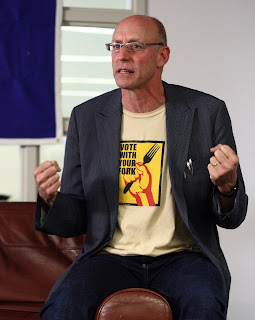
photo of Michael Pollan by Ragesoss

Monday, November 17, 2008

The Final Frontier According to Ptolemy, Kennedy, Hubble and Obama

Barack Obama has threatened NASA funding cuts. He should see this picture taken by the Hubble first

Of the dozens of constellations recorded by the ancient Roman astrologer Ptolemy, there is one shaped like a fish, tucked away deep in the Southern sky. He called it Piscis Austrinus, and the star that represents this fish's mouth is also the fish's brightest light. In fact, it's one of the brightest stars in the sky.

Its name is Fomalhaut (in Arabic, Fom al-haut means "mouth of the southern whale"), a young star just 200 million years old, 25 light years away (a distance about six billion times the circumference of the Earth).

In the autumn sky, it's the only first-magnitude star seen from the mid-northern latitudes -- in cities like Shanghai, Baghdad and Casablanca. It's no wonder that Fomalhaut, appropriately known as "The Lonely Star of Autumn," has made its way into Chinese, Persian and Arabic culture.

Its mystical quality has also made its way into Western culture. One of Fomalhaut's many literary references is in "Radio Free Albemuth," a novel by American science fiction writer Philip K. Dick, where it is the origin of an alien satellite.

But now, it's something entirely alien to Fomalhaut that is looking into its region of the universe -- NASA's Hubble Space Telescope. Orbiting 360 miles above the Earth's surface, it's the first and only space telescope to view the universe using primarily visible light.

The Hubble has taken a snapshot of one of the Lonely Star's planets: Fomalhaut b, a planet three times the mass of Jupiter. The image is the first one taken of a planet circling another star other than our own, using only visible light. It is the result of eight years of NASA's research.

Speaking about America's space program in an interview with Cleveland's WKYC-TV in February, President-elect Barack Obama said, "I want to do a thorough review because some of these programs may not be moving in the right direction and I want to make sure that NASA spending is a little more coherent than it has been over the last several years."

He has said that he will fund his education plan in part by reducing NASA's budget. This seems counterintuitive.

As Mr Obama reviews NASA, he should consider Hubble's picture of Fomalhaut b and its other major -- and no doubt inspirational -- accomplishments, such as giving us the most precise age of the universe (13.73 billion years). He should give the government's full support to NASA's continued success with this extraordinary piece of modern technology.

With his famous 1961 "Race to the Moon" speech, President Kennedy inspired a generation to study science, saying, "I believe that this nation should commit itself to achieving the goal before this decade is out, of landing a man on the moon and returning him safely to the Earth. No single space project in this period will more impressive to mankind or more important for the long range exploration of space."

In his WKYC interview, Mr Obama mentioned that he grew up with "Star Trek," saying he believes in "the final frontier." He should recall Mr Kennedy's inspirational words -- and perhaps expand his knowledge of astronomy beyond sci-fi television -- before he makes a decision that could draw the frontier's border at Fomalhaut b.

Of that, Ptolemy would surely approve.

The above image, taken with the Advanced Camera for Surveys aboard NASA's Hubble Space Telescope, shows the newly discovered planet, Fomalhaut b, orbiting its parent star, Fomalhaut. (Credit: NASA, ESA, P. Kalas, J. Graham, E. Chiang, E. Kite (University of California, Berkeley), M. Clampin (NASA Goddard Space Flight Center), M. Fitzgerald (Lawrence Livermore National Laboratory), and K. Stapelfeldt and J. Krist (NASA Jet Propulsion Laboratory))

Wednesday, November 5, 2008

Red States, Blue States, Green States

Obama's "New Energy for America"

As a senator, President-elect Barack Obama had a better-than-average voting record regarding the environment. But is his past record a good indicator of future performance as the Commander-in-chief?

The League of Conservation Voters (LCV), which rates Congress members' environmental records, gave Obama a score of 67% last year -- fourteen points above the average. His senatorial lifetime score was 86%. No wonder so many conservationists and environmentalists rallied behind his presidential campaign.

Mr Obama has a strong understanding of the environmental mess we're in. He co-sponsored the Senate's most forceful climate bill -- the Boxer-Sanders Global Warming Pollution Reduction Act. Its aim is to reduce carbon emissions 80 percent by 2050.

He also realizes that America's dependence on Middle East oil and the country's national security are intertwined. In an interview last year with Grist.org, he said, "our dependence on fossil fuels from the Middle East is distorting our foreign policies."

His "New Energy for America" plan is bold. It calls for, among other things, a $150 billion private-sector investment to create five million green jobs, saving more oil than is currently imported from Venezuela and the Middle East within ten years and the implementation of a cap-and-trade program to achieve the Boxer-Sanders goals.

Mr Obama's promise to require oil companies to use their windfall profits to give $500 back in immediate relief to individuals -- while an effective vote-enticer -- does not move the energy ball downfield towards independence. But his desire to create a "Green Jobs Corp" -- an organization that will give disadvantaged youths an opportunity to learn new work skills while helping their communities increase their energy efficiency -- is an inspired concept.

And he has found a good partner in Senator and Vice President-elect Joe Biden, who said at his debate with Governor Sarah Palin, "There are real changes going on in our climate...the cause is man-made...that's why the polar icecap is melting." He co-sponsored a bill to end the illegal trade in whale meat and another one to strengthen prohibitions on animal fighting. The LCV gave the senator a score of 95%.

The stage seems to be set for change, especially considering the Democratic majority in Congress. And no matter what Mr Obama accomplishes on the environmental front, he will most surely do better than America's outgoing chief. When President Bush makes his Oval Office exit in January, he will not only go down as the most unpopular American president in modern times, but also as the one with the worst environmental record in our lifetime. Change, indeed.

photo: Justin Sloan